Best Red Flashlights for Preserving Night Vision at Star Parties
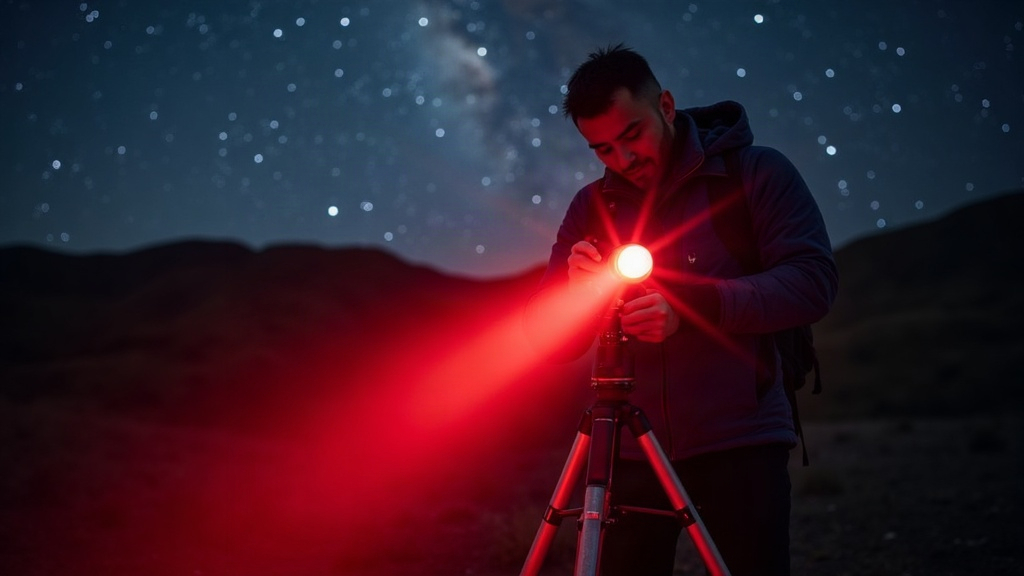
If you’ve ever had some stranger’s white headlamp torch through twenty minutes of hard-won dark adaptation at a star party, you already know why a decent red flashlight isn’t optional gear, it’s mandatory. The best red flashlights for astronomy rely on dim, adjustable, genuinely red LEDs (not pink, not orange-tinted) so you can read star charts, fiddle with equipment, and walk to your car without torching your eyes’ ability to pick up faint deep-sky targets.
Why Red Light Protects Night Vision
Your eyes run on two separate systems: cone cells (color, fine detail, bright light) and rod cells (low-light, black-and-white vision, the ones doing all the work at 2am). Full rod adaptation takes 20 to 30 minutes to build up, and a single burst of white light can erase it in about a second.
Rods are simply much less sensitive to long-wavelength red light (620-700nm) than they are to blue or white wavelengths. That’s the whole reason astronomers, night-shift workers, and the military have leaned on red illumination for decades. It gives you enough to function without dragging your adaptation back to square one.
Key takeaway: not every “red” flashlight actually behaves like one. Cheap versions slap a red filter over a bright white LED, and that setup still leaks enough white and blue light around the edges to annoy everyone else on the field. Real astronomy-grade lights use dedicated red LEDs paired with a dimmer circuit, not a filter trick.
What to Look for in an Astronomy Red Flashlight
- Dimmable brightness — You want a knob or button that runs from “can barely find the switch by feel” up to “bright enough to read a finder chart.” A single fixed brightness almost never hits the sweet spot.
- True red LED, not a filter — Filtered white lights tend to bleed blue around the edges. A dedicated red LED just runs cleaner.
- No strobe or memory modes — Tactical flashlights that default to strobe or max brightness the moment you turn them on are basically a small disaster at a star party.
- Low minimum output — The good ones can dip below 1 lumen, which is exactly what you need for reading eyepiece labels or glancing at a laptop screen behind a red gel.
- Hands-free option — A headlamp frees up both hands for nudging a mount or flipping pages in a Star Atlas at midnight.
- Battery life and type — AA or AAA cells are far easier to scrounge up at a remote dark-sky site. USB-rechargeable is convenient at home, but it’s a gamble if you forget to charge it before a three-hour drive out to the desert.
Top Picks by Category
Best Headlamp: Petzl Tikka or Rigel Systems Skylite
Petzl’s Tikka line comes with a real red LED mode and adjustable brightness, it’s reliable, light on your head, and easy to find at any outdoor shop. For something built specifically for stargazers, the Rigel Systems Skylite has been a favorite among amateur astronomers for years. Fully dimmable red LED, clip-on design, works equally well as a headlamp or clipped to a shirt pocket.
Best Handheld: Celestron Night Vision Flashlight or Orion RedBeam
Celestron’s astronomy-specific flashlight has a bright/dim red LED switch and a body sturdy enough to survive a drop into dewy grass at 11pm (trust me, it happens). Orion’s RedBeam mini is small enough to clip to a lanyard so it just hangs around your neck, ready the second you need to check a chart at the eyepiece.
Best Budget Option: Any AAA Red LED Keychain Light Under $10
Starting out and don’t want to spend much? A basic red LED keychain light from the hardware store aisle does the job for casual sessions. No dimming, sure, but it still beats the daylights out of your phone screen glowing in your face.
Best DIY Fix
Plenty of observers just tape red cellophane, red nail polish, or a few layers of theatrical lighting gel over a regular flashlight lens. It’s cheap and it works, just test it on your own eyes first since some materials let through more light than you’d guess.
Star Party Etiquette Reminders
- Never flick on a white flashlight once observing has started, not even “just for a second.”
- Keep your red light dim and angled down, never at someone else’s eyes or their telescope.
- Slap a red film over your phone screen or run a night-mode app before pulling up a digital star chart.
- Ask before walking up to someone else’s telescope with any light source in hand.
Frequently Asked Questions
Can I just use my phone’s night mode instead of a red flashlight? Phone night modes cut some blue light, but a lot of them are still bright enough, and leaky enough on the blue end, to chip away at your dark adaptation. Fine as a backup. Not a real substitute.
Does red light affect telescope views themselves? Nope. Red light doesn’t touch the optics or change what you see through the eyepiece. It only matters for your own eyes when you’re reading a chart or adjusting gear between observing sessions.
How dim is dim enough? Simple test: if you can read text at arm’s length without squinting, and a friend standing fifteen feet away barely notices your light at all, you’ve nailed it.
Conclusion
A good red flashlight is one of the cheapest upgrades in the entire hobby, and easily one of the highest-impact. Whether you go with a dedicated unit like the Rigel Skylite, a headlamp with a genuine red mode, or a five-minute DIY red-gel fix, the goal never changes: dim, truly red, adjustable light that lets you work at the eyepiece without wrecking the dark adaptation you spent half an hour building.