Can You See Saturn's Rings Through a 4-Inch Telescope in Light
Short Answer: Yes, Absolutely
A 4-inch (100mm) telescope will show you Saturn’s rings clearly, even from a light-polluted backyard, driveway, or rooftop. Saturn happens to be one of the rare deep-sky targets that shrugs off light pollution, simply because planetary viewing comes down to brightness and magnification, not dark skies. Galaxies and nebulae wash out under that orange sodium-vapor glow, sure, but Saturn stays bright enough to show you a crisp, ring-divided disc even from the middle of a city block.
That’s genuinely good news if you’ve been assuming a bright sky ruins everything. Saturn might be the single best “light pollution-proof” target in the entire solar system.
Why Light Pollution Doesn’t Wreck Planetary Views
Light pollution mostly scatters stray light across the sky, which kills contrast for faint, spread-out objects like nebulae and galaxies. Saturn plays by different rules. Consider what it actually is:
- Extremely bright. It sits around magnitude +0.5 to +1.2, outshining nearly every star near it in the sky.
- A point source blown up into a tiny disc through the eyepiece, so the glow behind it matters far less than your telescope’s optics and the magnification you’re using.
- High-contrast against itself. The rings and the planet’s body already have natural shading baked in, so you don’t need a pitch-black backdrop for that contrast to register.
Planets, in other words, are “surface brightness” targets. They punch straight through urban haze in a way faint fuzzy objects simply can’t.
What You’ll Actually See Through a 4-Inch Scope
With a decent 4-inch refractor or reflector pushed to 100-150x, here’s what to expect:
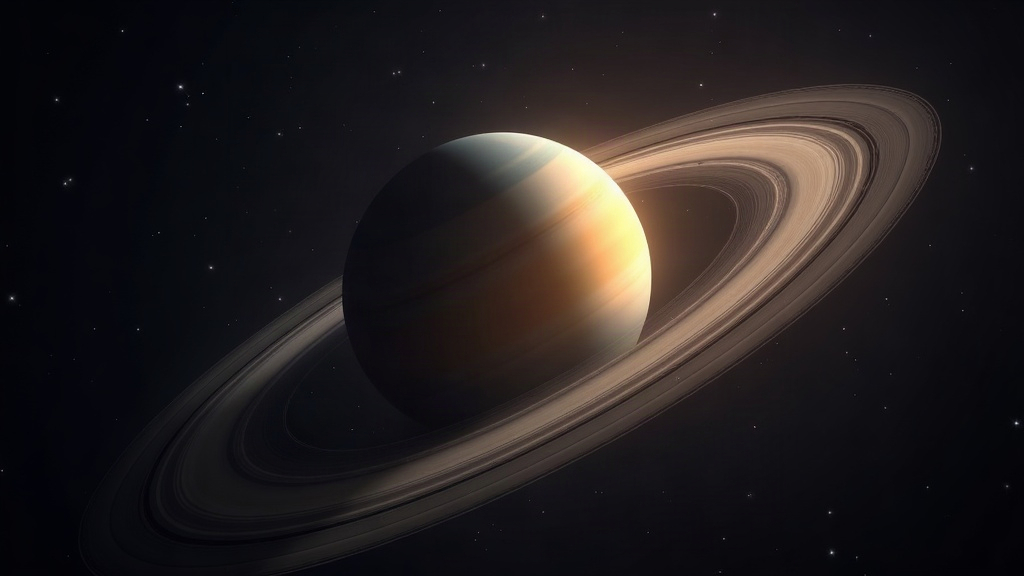
- A clearly oval, non-circular shape, the rings read as obviously separate from the globe itself.
- A visible gap of black space between the ring plane and Saturn’s disc.
- Faint cream and tan banding on the planet, assuming the air is steady that night.
- Titan, Saturn’s largest moon, sitting nearby as a tiny star-like pinprick.
What you probably won’t catch at 4 inches is the Cassini Division, that thin dark gap inside the rings themselves. That usually needs 6 inches of aperture or more, plus genuinely steady seeing. But the basic “yep, those are rings” view? Totally within reach.
Settings and Gear That Make the Difference
Use High Magnification
Saturn is small but bright, so don’t hold back on power:
- Start with a 10mm eyepiece, then move up to a 6mm, or pair a longer eyepiece with a 2x Barlow.
- Aim for 100x-180x on a 4-inch scope. That’s roughly where the rings suddenly “snap” into focus and stop looking like a blur.
Let the Planet Rise First
Wait until Saturn climbs at least 30° above the horizon. Lower than that, and you’re looking through a thicker wedge of atmosphere, which smears detail no matter how dark (or bright) your sky is.
Try a Simple Light-Pollution Filter (Optional)
Nebula or UHC filters are useless here, they’re built for a different job. A basic Moon & Skyglow filter, though, can take the edge off glare on nights when a streetlight is washing out your contrast.
Let Your Scope Cool Down
Bring the telescope outside 20-30 minutes before you start observing. A warm tube generates internal thermal currents that blur fine detail far more aggressively than any city light ever will.
Block Stray Light
Standing in a shadow, behind a fence, a garage wall, a tree, or just using a simple dew shield, cuts down glare from nearby streetlamps. Your eyes will thank you; contrast sensitivity improves almost immediately once stray light stops hitting your face.
Real-World Example
Plenty of city-dwelling observers using an ordinary 4-inch achromatic refractor (think $200-$400 beginner models) report seeing Saturn’s rings clearly from downtown balconies and suburban driveways under Bortle 7-8 skies. Even with a streetlamp sitting somewhere in the field of view, the rings stay visible, as long as that light isn’t shining straight into the eyepiece.
Quick Checklist for Best Results
- ✅ 4-inch aperture, well-collimated
- ✅ Magnification of 100x or higher
- ✅ Saturn at least 30° above horizon
- ✅ Scope cooled to outdoor temperature
- ✅ Shielded from direct streetlight glare
- ✅ Patience, wait for those brief moments of steady air (“good seeing”)
Conclusion
You don’t need a dark-sky preserve for one of astronomy’s most iconic sights. A 4-inch telescope, even sitting under heavily light-polluted skies, will reveal Saturn’s rings as a distinct structure wrapped around the planet, the kind of view that still makes first-time observers gasp out loud. Worry less about how dark your sky is and more about magnification, cooldown time, and blocking stray light. Do that, and Saturn will keep delivering, night after night, rings and all.