Comparing Hydrogen-Alpha Solar Telescopes for Prominences
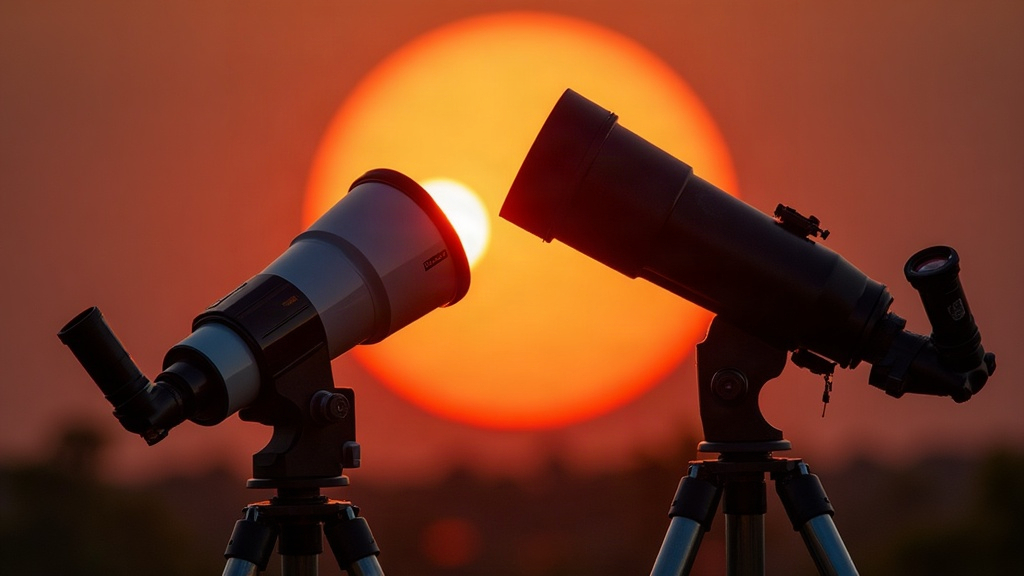
If you want to watch flaming prominences arc off the edge of the sun in real time, a hydrogen-alpha (H-alpha) solar telescope is really the only tool that does the job. And picking the right one comes down to three things: etalon bandpass, aperture, and how much blocking filtration you need for safe, high-contrast views.
Why H-Alpha Instead of White-Light Filters?
A standard white-light solar filter (glass or film) blocks nearly all incoming sunlight and shows you the photosphere: sunspots, faculae, that mottled granulation texture. It’s cheap, it’s safe, and it’s genuinely useful. But it shows you nothing happening above the visible surface. Nothing.
H-alpha telescopes isolate a razor-thin slice of light at 656.28 nanometers, the exact wavelength emitted by excited hydrogen atoms. That narrow band reveals the chromosphere, the layer sitting just above the photosphere, where you’ll catch:
- Prominences, glowing loops and plumes of plasma arcing off the limb
- Filaments, prominences seen edge-on against the disk, appearing as dark, thread-like structures
- Flares, sudden brightenings tied to magnetic reconnection
- Spicules and plage, fine surface texture that’s completely invisible in white light
This is genuinely dynamic viewing, not a static snapshot. Prominences visibly shift over the course of minutes, and dedicated observers often log noticeable changes within a single hour-long session. Set up a chair, pour some coffee, and just watch. It moves.
How H-Alpha Telescopes Achieve Safety
Safety in H-alpha observing comes from the whole optical train, not from a single front filter bolted onto an existing refractor (please, never try this with a generic filter and a department-store scope). A true H-alpha system relies on two or three components working in sequence:
- Energy Rejection Filter (ERF): mounted at the front aperture, it blocks the vast majority of incoming solar energy, meaning the heat and most of the visible/UV/IR light, before any of it reaches the optics.
- Etalon: a precision interference filter (often temperature-tuned) that narrows the remaining light down to a bandpass measured in angstroms (Å), isolating the H-alpha line specifically.
- Internal blocking filter: a secondary filter near the eyepiece or camera that mops up any residual stray light.
Because the ERF handles the dangerous heat and intensity right at the front of the optical path, these systems end up inherently safer for long observing sessions than any DIY white-light rig, provided you buy a complete, purpose-built unit from a reputable manufacturer. Never cobble one together from surplus parts. That’s not where you want to save money.
Key Specs That Actually Matter
Bandpass (Angstroms)
This is the single most important number for prominence and surface detail:
- ≤0.7Å: Excellent surface detail, filaments, plage, fine structure, alongside strong prominences. Found on premium units (think Lunt LS60THa, or the Daystar Quark Chromosphere paired with larger apertures).
- 0.8–1.0Å: Good all-around performance; still shows strong prominences with decent disk detail. Most Coronado PSTs and entry-level Lunt models land right in this range.
- >1.0Å: Prominences stay bright and easy to spot, but surface detail softens noticeably, almost like looking through a light haze.
If prominence-watching is your main goal rather than chasing fine disk detail, a wider bandpass around 1Å is perfectly satisfying, and it’s considerably cheaper too.
Aperture
- 40mm (e.g., Coronado PST): compact, affordable, shows prominences beautifully at low-to-moderate power. Resolution for disk detail is limited, though.
- 50–60mm: the sweet spot for most serious amateurs. You get noticeably sharper surface detail without a massive jump in price.
- 70–100mm+: professional-grade resolution, but cost climbs steeply, and so does the fiddliness of precise thermal tuning.
Single-Stack vs. Double-Stack
Many etalon systems can be “double-stacked” by adding a second etalon in series. This narrows the bandpass even further (improving contrast on filaments and surface detail), but it comes at the cost of overall brightness and a noticeably higher price tag. Think of double-stacking as a worthwhile upgrade path down the road, not something you need to chase on day one.
Popular Models Compared
- Coronado PST (40mm, ~1Å): the classic entry point. Affordable, portable, prominences look great right out of the box, but it’s fixed-focus and limited when it comes to disk detail.
- Lunt LS35THa / LS50THa: modular pressure-tuned etalons, upgradeable blocking filters, solid build quality, good value for intermediate observers who’ve outgrown a PST.
- Lunt LS60THa / LS80THa: serious surface detail here, double-stack ready, and a favorite among imagers.
- Daystar Quark: an eyepiece-style etalon you attach to an existing achromatic refractor (with a proper front energy rejection filter in place). It’s a cheaper path to larger-aperture H-alpha views, but it demands careful setup and a genuinely compatible scope.
Practical Buying Advice
- Match aperture to your main interest: smaller apertures for casual prominence viewing, larger apertures with tighter bandpass if you’re after filament and flare detail.
- Budget for the whole package, not just the headline unit, including any required front ERF accessories if you’re going the Quark/eyepiece-filter route.
- Check the etalon’s tuning range before buying. Some units need precise temperature or tilt adjustment to center on the H-alpha line, and that has a real learning curve.
- Never, under any circumstances, substitute a cheap neutral density or photographic filter for a certified ERF. Permanent eye damage can happen instantly, with no warning.
Conclusion
For safely enjoying solar prominences, a dedicated H-alpha telescope with a factory-matched ERF, etalon, and blocking filter is the only responsible choice, full stop. Beginners do well with a 40mm, ~1Å instrument like the Coronado PST. Those chasing fine chromospheric detail should look toward 50–60mm scopes with sub-1Å bandpass, upgrading to double-stack configurations once the budget allows. Whatever you choose, buy a complete, purpose-built system. The sun rewards careful equipment choices with some of the most dynamic, alive views in all of astronomy.