How to Track Mars Retrograde Motion From Your Backyard
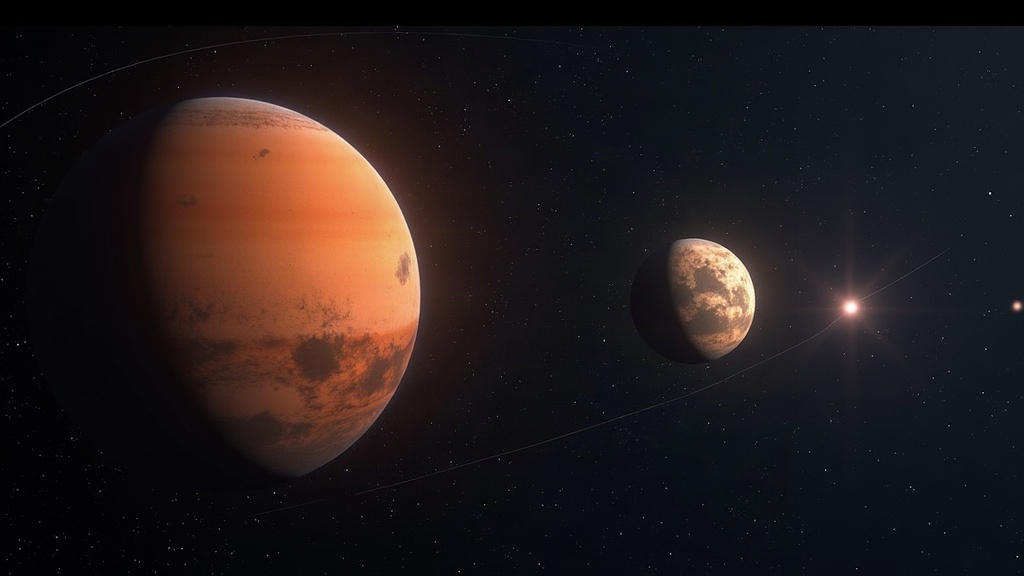
Every couple of years, Mars does something strange. It slows down, stops, backs up against the stars for a while, then shrugs and continues on its normal eastward path. Astronomers call this retrograde motion, and despite the fancy name, you don’t need a telescope, an observatory membership, or a physics degree to watch it happen. Grab a star chart, a notebook, and commit to a handful of clear nights spread across several weeks. That’s really it. Any backyard observer can trace Mars’s odd loop across the sky and walk away understanding exactly why it occurs.
What Is Retrograde Motion, Really?
Here’s the thing: Mars never actually reverses course. Retrograde motion is an optical illusion, a trick of orbital geometry rather than any change in the planet’s real trajectory. Earth moves faster around the Sun than Mars does, so every couple of years we overtake it on the inside lane, like a faster runner lapping a slower one on a track. For a few months, from our vantage point, Mars seems to drift backward (westward) against the fixed background stars.
A few things worth keeping in your back pocket:
- Mars isn’t reversing anything physically; only its apparent position in our sky shifts.
- These retrograde windows show up roughly every 26 months, clustering around what’s called Mars opposition, the moment Earth sits squarely between Mars and the Sun.
- Each loop runs about 60 to 80 days, and Mars only creeps a few degrees across the sky during the whole stretch.
- You notice it so easily because Mars is bright and distinctly reddish, easy to spot with nothing but your eyes.
Step 1: Find Out When Mars Is in Retrograde
Don’t just walk outside and hope. Check an online ephemeris or a planetarium app, Stellarium and SkySafari both work well, or search “Mars retrograde dates” and you’ll get the current window instantly. Jot down three specific dates:
- Start of retrograde, when Mars appears to freeze in place (the first stationary point).
- Opposition, when Mars sits closest to Earth, shines at its brightest, and marks roughly the midpoint of the loop.
- End of retrograde, when Mars shakes off the backward drift and resumes its usual eastward crawl.
Once you have these three dates mapped out, you can build an actual observing plan instead of just guessing and hoping you catch something interesting.
Step 2: Choose a Fixed Reference Point
The easiest trick for actually seeing retrograde motion is comparing Mars against nearby stars that aren’t going anywhere. Here’s how:
- Figure out which constellation Mars is currently passing through. Recent loops have taken it through Gemini, Taurus, and Virgo.
- Pick out two or three bright, unmistakable stars close to Mars to use as anchors.
- Document the scene somehow, a phone photo on a tripod, a wide-angle lens shot, or just a quick pencil sketch in a notebook works fine.
Step 3: Observe on a Regular Schedule
Showing up consistently beats owning expensive gear. Try this rhythm:
- Once a week in the weeks leading up to retrograde.
- Every 3 to 4 nights once the retrograde loop actually begins, since that’s when the motion becomes obvious.
- Roughly the same time each night (give or take an hour), because Mars’s position relative to your horizon also shifts purely from Earth’s rotation, and that can muddy your comparisons if you’re sloppy about timing.
A simple method that works well: hold your phone at arm’s length, frame a wide shot that captures both Mars and your reference stars, or sketch the relative positions on grid paper. Do this every few nights for several weeks, then lay the images or sketches side by side in order. You’ll watch Mars creep one direction, pause, reverse, pause again, then pick back up. It’s oddly satisfying.
Tools That Help (But Aren’t Required)
- Binoculars (7x50 or 10x50): Handy for picking out dimmer reference stars you might miss with the naked eye.
- A small telescope: Not necessary for tracking the retrograde loop itself, but a nice bonus near opposition if you want to glimpse Mars’s disk and its polar ice cap.
- Free apps: Stellarium, SkySafari, and Sky Tonight all plot Mars’s path and retrograde loop right on a live sky map, which saves a lot of guesswork.
- A camera on a tripod: Snap a photo every few nights from the exact same spot and you’ve basically built yourself a DIY time-lapse.
Why This Matters Beyond the Backyard
This isn’t just a cute weekend hobby project. You’re recreating the exact puzzle that stumped astronomers for roughly 2,000 years, the same oddity that eventually pushed Copernicus and later Kepler toward the realization that planets orbit the Sun, not Earth. Ancient skywatchers built increasingly elaborate (and wrong) models trying to explain Mars’s backward loops without giving up on an Earth-centered universe. When you trace that same loop yourself tonight, you’re essentially rerunning one of the pivotal observations in the history of science, using the same sky those astronomers had access to.
Best Time to Start
Begin about 2 to 3 weeks before the predicted start of retrograde. Why bother starting early? Because you want to record Mars’s normal, forward motion first, so you have a clean baseline. Without that baseline, the backward swing around opposition is less obvious and harder to confirm with confidence.
Conclusion
Tracking Mars through a retrograde cycle ranks among the most rewarding naked-eye projects in amateur astronomy, and it costs nothing but patience. Know your dates, lock in a few steady reference stars, and check in on a consistent schedule. Give it a few weeks and you’ll watch Mars pause, drift backward, pause again, and resume its path, a small but vivid reminder of just how elegant the mechanics of our solar system really are.