Decoding the Faint Radio Echoes of Fast Radio Bursts
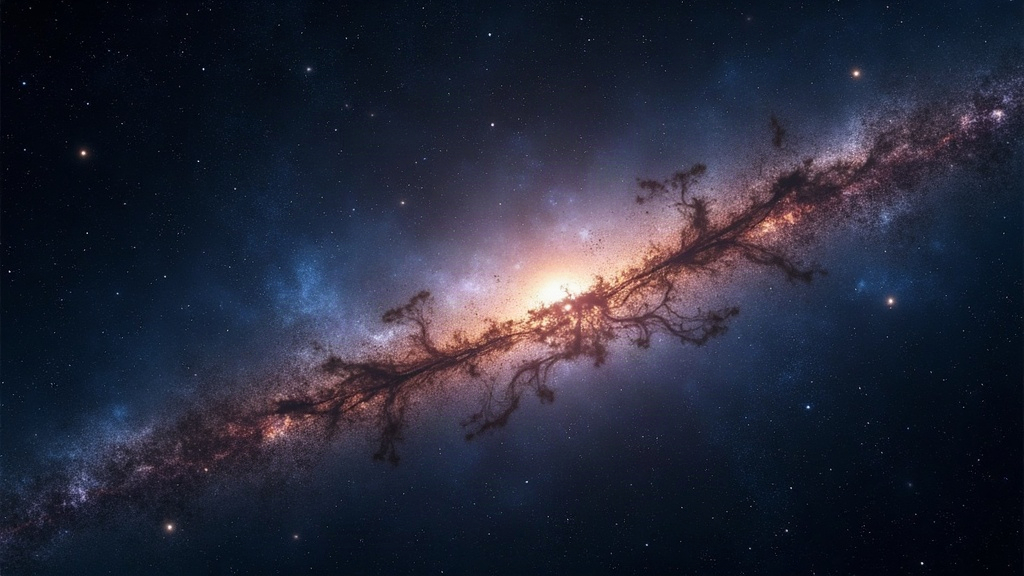
Imagine catching a glimpse of a flash in the night sky that lasts just a thousandth of a second, yet unleashes more energy than our Sun produces in a century. That is a fast radio burst (FRB). These millisecond-long radio energy spikes travel across billions of light-years of deep space. By decoding their faint, distorted echoes, astronomers are essentially using them as cosmic flashlights to illuminate the invisible structures of the universe. We are also finally zeroing in on the truly exotic stellar corpses that create them.
What Exactly Is a Fast Radio Burst?
A fast radio burst is a brutally intense pulse of radio waves. It flashes for mere milliseconds. Yet, in that literal blink of an eye, it can dump more energy into the void than our Sun manages over several days. Astronomer Duncan Lorimer stumbled onto the very first one back in 2007. He was digging through dusty archival pulsar data from the Parkes Observatory in Australia. At first, the scientific community brushed the signal off as a bizarre instrumental glitch or a terrestrial fluke.
Fast forward to today, and we have cataloged thousands of these events. The vast majority originate from host galaxies billions of light-years beyond our own.
Here are the defining fingerprints of an FRB:
- Extreme brevity: They usually last anywhere from 1 to 10 milliseconds.
- High energy output: You are looking at a solar day’s worth of power packed into a microscopic fraction of a second.
- Dispersion: The signals do not arrive all at once. Higher radio frequencies hit our telescopes first, followed slightly later by lower frequencies. This smear is the classic signature of radio waves plowing through ionized gas in deep space.
Why Are FRB Echoes So Hard to Decode?
When astronomers talk about an FRB “echo,” they do not mean a literal reflection off a distant canyon wall. They are talking about how the original, pristine pulse gets smeared, delayed, and violently scattered as it bulldozes its way through interstellar and intergalactic space. Decoding this messy aftermath is a mathematical nightmare for a few specific reasons.
Dispersion Measure Complications
Space is not completely empty. As radio waves surf through the thin soup of free electrons drifting between galaxies, they get bogged down. Lower frequencies experience more drag and get delayed relative to higher, punchier frequencies. Astronomers measure this delay using a metric called the dispersion measure (DM). In theory, the DM tells you exactly how much cosmic mud the signal trudged through, which gives you a great estimate of how far it traveled. The headache? It is incredibly difficult to untangle the electron density of the FRB’s home galaxy from the vast, diffuse intergalactic matter sitting between that galaxy and Earth.
Scattering and Multipath Propagation
Imagine shining a flashlight through dense fog. The beam diffuses and scatters. Radio waves face a similar problem when they hit turbulent clouds of magnetized plasma. These clouds bounce the signal down dozens of slightly different paths. Instead of a clean, sharp spike hitting our detectors, the burst arrives as a smeared-out tail. Stripping away this scattering effect to reveal the burst’s true, original shape requires heavyweight signal-processing algorithms that push modern supercomputers to their absolute limits.
Repeating vs. One-Off Bursts
Are we looking at a cataclysmic explosion or a stuttering engine? Some bursts flare up just once and disappear into the dark forever. Others, like the famously active FRB 121102, erupt repeatedly from the exact same coordinates. Sorting these events into neat categories is vital. A repeater implies an object that survives the outburst, while a one-off flash might signal something being violently destroyed. Because we cannot monitor the whole sky round-the-clock with perfect sensitivity, classifying them often remains a frustrating guessing game.
How Astronomers Detect and Analyze FRBs
You cannot catch these fleeting signals with a standard backyard telescope. Modern FRB hunting requires massive, purpose-built radio arrays and serious computational horsepower.
- CHIME (Canadian Hydrogen Intensity Mapping Experiment): Located in British Columbia, this telescope looks like four massive snowboard half-pipes. Because it has no moving parts and stares at a huge swath of the sky simultaneously, CHIME has captured thousands of FRBs since it woke up in 2018.
- ASKAP (Australian Square Kilometre Array Pathfinder): When you need to pinpoint an exact cosmic address, you turn to ASKAP. This array can localize a burst to its specific host galaxy with arcsecond precision, finding the literal needle in the haystack.
- Machine learning classifiers: The sheer volume of data pouring out of these telescopes is staggering. Humans could never review it manually. Algorithms are trained to ruthlessly filter out local radio-frequency interference (like cell phones, satellites, or airplane radars) and isolate genuine deep-space bursts in real time.
Once an algorithm flags a legitimate strike, astronomers pivot optical telescopes to those coordinates. If they can spot the host galaxy, they calculate its distance using redshift and fine-tune their dispersion models.
What Causes Fast Radio Bursts?
We still do not have a single, unified theory that neatly explains every FRB on the books. However, there is a very clear prime suspect: magnetars.
A magnetar is a highly magnetized, incredibly dense neutron star. If you dropped one halfway between Earth and the Moon, its magnetic field would be strong enough to wipe the data off every credit card on our planet. In 2020, astronomers finally caught a lucky break. They detected a distinct, FRB-like radio flash erupting from a known magnetar (SGR 1935+2154) right here inside our own Milky Way. That smoking gun directly linked the FRB phenomenon to a known class of stellar objects for the very first time.
Still, the universe is wild, and other exotic theories are floating around to explain the outliers. These include:
- The violent collision of two neutron stars.
- Blitzars (heavyweight neutron stars that suddenly collapse into black holes under their own gravity).
- Complex magnetic snapping between a neutron star’s outer magnetosphere and dense surrounding plasma.
Why Decoding FRBs Matters
This is not just about solving a neat astrophysical trivia question. FRBs are rapidly becoming some of the most powerful tools in a cosmologist’s toolkit.
- Mapping “missing” baryonic matter: For decades, cosmological models predicted a certain amount of normal matter in the universe, but our telescopes could not find it all. By tracking the dispersion measure of FRBs, scientists can map the invisible webs of ionized gas stretching between galaxies. The bursts are literally highlighting the universe’s missing matter.
- Testing fundamental physics: When you have a signal that has traveled for five billion years, tiny discrepancies matter. The incredibly precise arrival times of different radio frequencies allow physicists to test the strict limits of Einstein’s relativity, search for hypothetical photon mass, and poke holes in established physics.
- Probing galactic environments: A burst carries the chemical and physical signature of the exact place it was born. Decoding that signature tells us about the gas density, magnetic fields, and turbulent structure of host galaxies that are simply too far away to observe by traditional means.
Conclusion
We are barely scratching the surface of the fast radio burst phenomenon. Every time a telescope catches a new, distorted echo, we get a slightly clearer picture of the violent, magnetar-driven engines hiding in the deep universe. We also get a better map of the invisible cosmic web those signals fought through to reach us. The next generation of heavy-duty hardware, like the sprawling Square Kilometre Array, is about to come online. When it does, this trickle of millisecond messengers is going to turn into an absolute flood. The dark universe is talking, and we are finally learning how to listen.